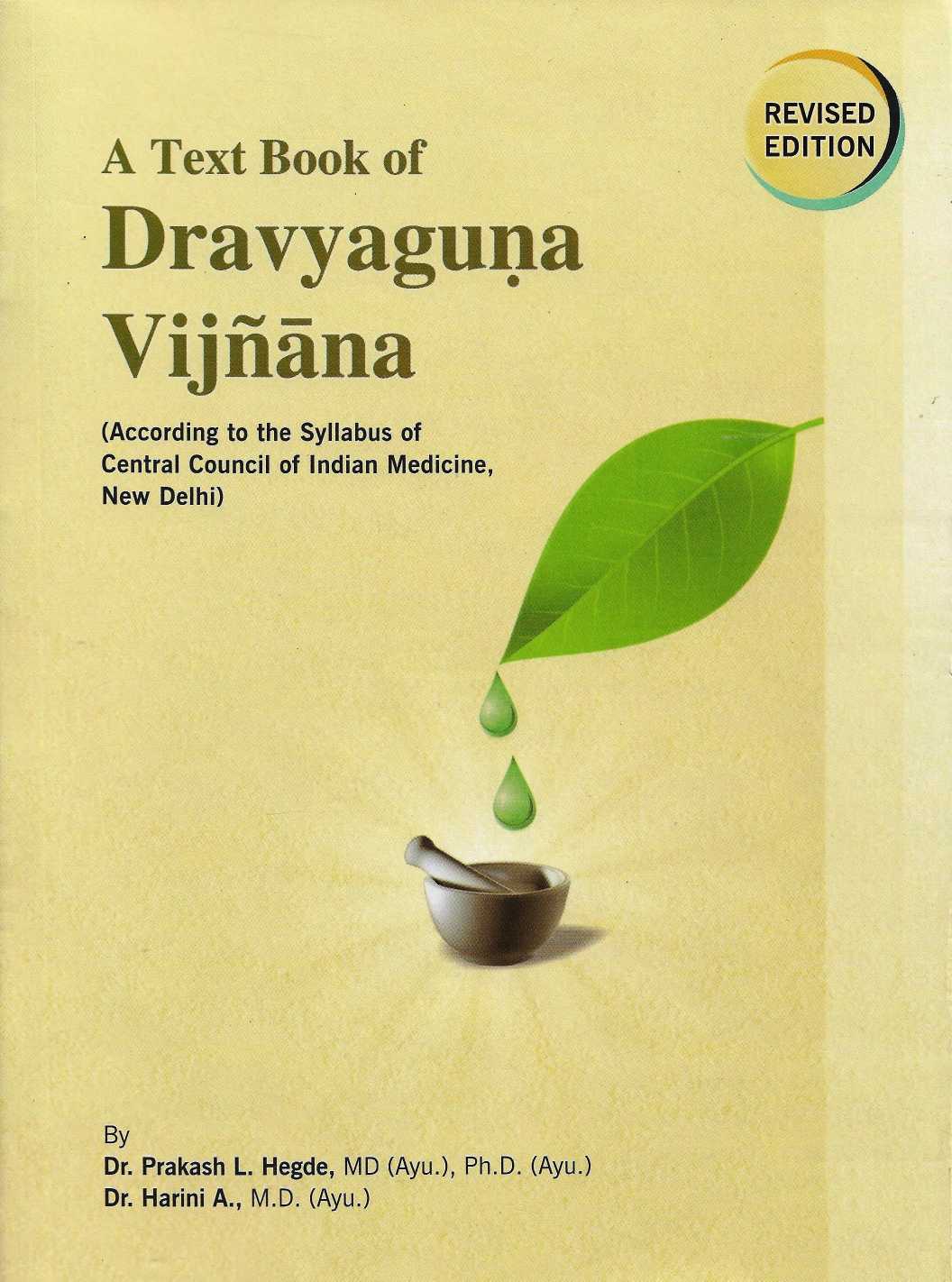
Text Book Of Dravyaguna Vigyan Vol. 1
Dr. Prakash L.Hegde · Chaukhambha Publications
About the Book This book written by Dr. Prakash L Hegde M.D(Ayu), PhD(Ayu) and Dr. Harini A M.D(Ayu) is a good addition to the field of Dravyaguna. The book is written as per new CCIM Syllabus which consist detailed and essential information about 104 medicinal plants. Method of explanation is very systematic and information is very useful which are collected from different classical texts, nighantus, and other relevant modern text books which enables the reader to have comprehensive knowledge about the medicinal plants. The resourceful information given in the book is very handy for BAMS (undergraduates), M.D/M.S (post graduates), academicians , researchers and industrialists. Preface (Part-I) Man from the very beginning has been aware of the problems of life and for a very long time has been taking care of his health through various means. Ayurveda, which literally means the science of life, is the natural healing system of India, its traditional medicine going back to ancient times. Its originality and holistic approach whose principles of therapeutics are applicable universally remain time tested even to this day. In the course of its life science, plants make an immense impact as either food or medicine. Plants affect different facets of life, such as cultural, economical, medical and spiritual. Since time immemorial, plants have been extensively used by man for maintenance of health and for treatment of myriad of illnesses. This has been discovered from the clay tablets etched by early man before he was able to record the medicinal value of plants on papyrus parchment. In India, the earliest mention of the use of medicinal plants is found in the Rigveda which was written between 4500-1600 B.C. A detailed account of the world's first symposium on medicinal plants is given in the first chapter of Vrihat Samhita and since 1600 B.C., the amount of literature on this subject is boundless. In the course of evolution, long before, Jagdish Chandra Bose demonstrated the sign of life in plants by his scientific experiments, Vedic seers realized it in Chandogya Upanishad (6-11.1). But it was only in the period of the Ayurvedic Samhitas, that there were serious attempts in studying plants scientifically and systematically. It is interesting to observe that the knowledge about plants is based on a sophisticated, indigenous knowledge category called Dravyaguna. Though termed as a discipline only during Nighantu period by Narahari, author of Raja Nighantu, the classical texts of Ayurveda, i.e. Brahatrayee stand testimony to the fact that Dravyaguna (Concepts) formed an integral part of the science in understanding the mechanism of action of plants (food/medicine) on man. Importance of Dravyaguna One of the renowned scholars of Dravyaguna of Yester- year, Prof. P.V. Sharma has aptly defined Dravyaguna as, Dravyaguna is a science which deals with Guna (Properties), Karma (Actions) and Prayoga (Therapeutics) of Dravya (Drugs). In the context of Dravyaguna, Dravya refers to Karya Dravyas only. As previously pointed out, Narahari, author of Raja Nighantu laid emphasis on Nighantu (Encyclopedia) by stating that Nighantus form an integral part of a Physician. Acharyas used medicinal plants judiciously as food and medicine. Ayurveda is well known as the "Triskandha Ayurveda" which refers to the triads or three pillars of Ayurveda. One among these is the Aushadha. Hence an in-depth and systemic knowledge of Ausadha is indispensable for Swastha (Healthy) and Atura (Diseased). For successful treatment, co- ordination and co-existence of Chatuspada is extremely essential. These are Bhisak (Physician), Dravya (Medicines), Upasthata (Nurse/Attender) and Rogi (Patient), which form the four limbs of the treatment. On keen observation, Dravya (Medicine) stands only second, reiterating its importance in treatment. It goes without saying the importance of knowledge of Dravya i.e., Dravyagu
Buy NowIndia's trusted online book store